
There have been assertions that clips of Democrats, such as Chuck Schumer, in a Democrats on Common Sense Immigration video, were “taken out of context”. We know Democrats and the media make it a practice of taking things out of context, so that’s apt projection in a desperate attempt to deflect.
If Chuck Schumer stating “illegal immigration is wrong, plain and simple” was taken out of context, and in a full context actually meant the opposite — that would actually have been better. Unfortunately that was not the case. Here is the full video and transcript for context — he said what he said, and he meant it.
Long story, short: jump to 00:10:34 for his Seven Key Principles wherein he makes clear his anti-illegal immigration stance, which was prevalent and bipartisan position at that time.
Senator Charles E. Schumer
Remarks at the Migration Policy Institute
Immigration Law and Policy Conference
June 24, 2009
https://www.migrationpolicy.org/file/1460
Transcript
Opening and Thanks
Thank you, Dean, and it is great to be here, and I want to thank you and everyone here for coming. I can tell you I hope my speech goes a little better this morning than the one I gave in Brooklyn a few weeks ago, because at the end of the speech, a senior citizen who was in the audience came over to me and said, Senator, I thought your speech was absolutely awful. But then someone standing next to him put his hand on my shoulder and said, Don’t worry, he just repeats what everyone else is saying. I mean...
Anyway, it is good to be here. I want to thank my friend Doris Meissner for inviting me to share thoughts. Doris and I go way back in these immigration struggles and fights, and she’s done a great job both in and out of government in terms of moving reform forward and moving us to a rational policy of immigration.
And I want to just share with you today some thoughts on immigration reform, the prospects of achieving it in 2009, and outline the main principles that will be part of the legislation that will be introduced later this year.
First, as you note, Doris was a great public servant for many years at an agency that many of us old-timers still call INS. It is no surprise to me that she continues to serve her country through her cutting-edge research and publications at the Migration Policy Institute, and her research just makes tremendous contributions. It’s rare when somebody writes something that just about everybody in the immigration field says, I must read that right away, but that’s Doris Meissner.
And when she invited me to speak to you, I did not know I’d be delivering my remarks before the White House’s summit on immigration reform. And while I can imagine many of you would have preferred this speech occur the day after the summit rather than the day before, in the hopes that I could tell you what transpired, I can tell you that there is no better time for this speech than today.
Today, I want to share with you the core of what I will tell the President tomorrow during our meeting. And the very first thing I’ll tell the President is something that I think will sound familiar. When the President asks me whether Congress can pass comprehensive immigration reform, this Congress, I will smile and say, Mr. President, yes, we can. I will tell him that all of the fundamental building blocks are in place to pass comprehensive reform this season and even possibly this session, rather, and even possibly later this year.
Optimism Despite Pundits
For the past several weeks, pundits, columnists, reporters have almost all been saying the prospects for comprehensive immigration reform look bleak. They say that immigration reform is an uphill battle and that there are not enough votes in Congress for reform and that the situation is altogether dark. But to all of these naysayers and to all the people who are so desperately looking to their government for leadership on this critically important issue, I say this. It is darkest just before the dawn, and I promise you, we’ve been through the darkness already, and a new day is dawning.
First of all, I have no doubt that President Obama has an unyielding commitment to achieving comprehensive immigration reform, and I truly believe that his leadership will be the critical difference in getting us over the hump this time around.
I also want to take this opportunity, of course, to recognize the remarkable leadership that my predecessor on the Immigration Reform Subcommittee, Senator Kennedy, provided to that subcommittee and to the nation for the last 46 years. He served with great distinction on that committee and was at the center of all of the critical immigration debates of our time. His leadership will truly be missed, and no one, no one can fill his large shoes.
Now, when Senator Kennedy relinquished his post as chairman of the Immigration Subcommittee to focus on health care, I had to ask myself whether I truly believed we could accomplish immigration reform or whether leading this subcommittee would be tantamount to embarking on a fool’s errand. At the time I made the decision to take over the Immigration Subcommittee, there were several other subcommittees I could have chosen to chair instead, any of which would have presented an opportunity to make large changes for both New York and America. So if I didn’t believe we could accomplish immigration reform in this session, I would never have chosen to accept the Immigration Subcommittee post.
Committees of inaction and legislative black backwaters are not the places in which I thrive. And since the day I became chairman of the Immigration Subcommittee, I’ve worked hard each day to achieve immediate positive results while never losing sight of the larger goal of building consensus for comprehensive reform. As an example, I do not believe that a bipartisan bill can be enacted if my colleagues on the other side of the aisle do not believe that Democrats are serious about enforcement.
Recent Enforcement Steps
For this reason, I recently helped obtain a commitment from both Attorney General Holder and Secretary Napolitano to ensure that Immigration and Customs Enforcement has the necessary Title 21 authority to perform investigations and make arrests in order to assist our government’s comprehensive efforts against the violent drug weapons and human smuggling cartels on our border. For far too long, we’ve had three separate agencies, all with different missions, each trying to stop these cartels individually.
The cartels that smuggle drugs and illegal aliens have integrated their activities, and now our federal agencies will have a better integrated response to them. This alliance with Secretary Napolitano will also soon yield additional positive results, such as providing DHS with enhanced authority to seize real property used by human traffickers and to crack down on employers who knowingly hire and exploit illegal immigrants to perform cheap labor in atrocious working conditions.
Other short-term reforms are also critical to laying the groundwork for comprehensive immigration reform. For instance, in conjunction with the Attorney General, we are increasing funding for the EOIR Legal Orientation Program. These funds will ensure that our immigration courts are correctly deciding as many cases as possible in the first instance. The savings created by this program will more than pay for the appropriations requested. Far fewer judicial and government resources will be expended because the courts will need to grant far fewer continuances and meritorious claims will be readily identified by all parties and quickly adjudicated without the need for unnecessary appeals.
Finally, I’m also asking appropriators to increase funding for refugee settlement. These funds will assist our most vulnerable and sympathetic immigrants to build new lives in the U.S. And many of these immigrants are Iraqi and Afghani refugees who risked their lives to assist our troops on the battlefield and now live in the United States because they’re no longer safe at home.
But even as we accomplish these immediate goals, I assure you, we remain intensely focused on our ultimate goal, passing comprehensive immigration reform as quickly as possible. The time for reform is now, and we all know, just about everyone knows, our system is badly broken. And as Pastor Joel Hunter, one of the leading evangelical ministers in our country, eloquently told the Immigration Subcommittee last month, our broken system forces good people to break the law because we give people no option to act lawfully. I encourage all of you to listen to his moving testimony on our Judiciary Committee’s website.
Hearings Roadmap
In furtherance of our efforts to pass immigration reform, we’ve convened a series of hearings. entitled, Road to Comprehensive Immigration Reform in 2009, Clearing the Hurdles.
The first hearing examined whether comprehensive immigration reform could be enacted in 2009. The answer, of course, was yes.
The second hearing examined the current state of our border security and the remaining steps that need to be taken to achieve operational control over the entire border.
I will also be holding two more hearings in July.
The first hearing will consider all of the existing ideas and solutions for achieving a simple and workable biometric-based employment verification system.
The second hearing will determine how to best structure our employment-based immigration system for the future.
Seven Key Principles
00:10:34
Well, during the last few months, I’ve thought long and hard about what an immigration bill must look like in order to obtain 60 votes in the Senate. After many meetings with stakeholders, other members of Congress, I truly believe that the fundamentals are in place for immigration reform if we coalesce against around seven key principles that the American people overwhelmingly support.
The main idea that underlies each of these seven principles is that the American people are fundamentally pro-legal immigration and anti-illegal immigration. We will only pass comprehensive reform when we recognize this fundamental concept.
The following seven principles are all based on this concept and comprise what I believe to be the framework for a bill that can receive overwhelming and bipartisan congressional support.
First, illegal immigration is wrong. And a primary goal of comprehensive immigration reform must be to dramatically curtail future illegal immigration.
Second, operational control of our borders through significant additional increases in infrastructure, technology, and border personnel must be achieved within a year of enactment.
Third, a biometric-based employer verification system with tough enforcement and auditing is necessary to significantly diminish the job magnet that attracts illegal aliens to the United States and to provide certainty and simplicity for employers.
Four, all illegal aliens present in the United States on the date of enactment of our bill must quickly register their presence with the United States government and submit to a rigorous process of converting to legal status and earning a path to citizenship, or face imminent deportation.
Five, family reunification is a cornerstone value of our immigration system. By dramatically reducing illegal immigration, we can create more room for both family immigration and employer-based immigration.
Six, we must encourage the world’s best and brightest individuals to come to the United States and create the new technologies and businesses that will employ countless American workers, but must discourage businesses from using our immigration laws as means to obtain temporary and less expensive foreign labor to replace capable American workers.
And finally, seven, we must create a system that converts the current flow of primarily low-skilled illegal immigrants into the United States into a more manageable and controlled flow of legal immigrants who can be absorbed by our economy.
Let me elaborate.
Illegal Immigration is Wrong
The first of these seven principles is that illegal immigration is wrong, plain and simple.
Until the American people are convinced that we will stop future flows of illegal immigration, we will make no progress on dealing with the millions of illegal immigrants who are here now and on rationalizing our system of legal immigration. It’s plain and simple and unavoidable.
When we use phrases like undocumented workers, we convey a message to the American people that their government is not serious about combating illegal immigration, which the American people overwhelmingly oppose.
If you don’t think it’s illegal, you’re not going to say it. I think it is illegal and wrong, and we have to change it.
Above all else, the American people want their government to be serious about protecting the public, enforcing the rule of law, and creating a rational system of legal immigration that will proactively fit our needs rather than reactively responding to future waves of illegal immigration.
People who enter the United States without our permission are illegal aliens, and illegal aliens should not be treated the same as people who entered the U.S. legally.
To the advocates for strong, fair, effective, comprehensive immigration reform, and I’m certainly one, I say to you that the American people will never accept immigration reform unless they truly believe that their government is committed to ending future illegal immigration. And any successful, comprehensive immigration reform bill must recognize this fact.
I have spoken to many advocates in the past several months, and one of the main reasons I’m optimistic about achieving reform this time around is the advocates understand the need to embrace this principle during the current debate.
Border Security
Second, any immigration solution must recognize that we must do as much as we can to gain control of our borders as soon as possible. But we also need to set the record straight. The American people need to know that because of our efforts in Congress, our border is far more secure today than it was when we began debating comprehensive reform in 2005.
Between 2005 and 2009, a vast amount of progress has been made on our borders and ports of entry. The progress includes 9,000 new Border Patrol field agents in the last four years, construction of a 630-mile border fence, or 630 miles of border fence, that create a significant barrier to illegal immigration on our southern land border.
And third, the implementation of new border technologies which serve as force multipliers and allow the border patrol to maintain control of larger segments of the border with fewer agents.
All of these measures have contributed to what the New York Times reported on May 15, 2009 is, quote, an extraordinary decline in the number of Mexican immigrants going to the United States, unquote. Those of us who support comprehensive reform have shown our commitment to tough and serious border enforcement.
But opponents of comprehensive reform continue to repeat the same old argument that no conversation regarding immigration reform should even begin. Until we show that we’re serious about securing the border. Well, to those people, I say the time has come to end the divisive rhetoric about our border. It’s time for those who reflectively parrot the border-first mantra to re-engage in the long-promised yet long-delayed conversation regarding reforming our nation’s broken immigration system.
All that is needed now to give the Border Patrol the additional infrastructure, technology, and personnel to ensure that it’s impossible to unlawfully cross the border without being detected and apprehended. This technology is available, will be deployed in the near future, while at the same time, more border personnel is deployed in the short term until the technology is up and running. These measures for additional border security must be part of any comprehensive immigration reform bill.
Job Magnet / Verification System
Third, we must recognize that illegal immigration will never seriously be stifled unless and until we end the job magnet currently engendered by the seriously flawed I-9 regime.
As we speak, any individual who steals a social security number and has access to a credible fake ID can get a job in the United States. The current system creates havoc for both employers and employees and no one has any certainty. Employers who accept all credible documents in good faith are not guaranteed they’ll never be targeted by the ICE for turning a blind eye toward illegal immigrants in their workplace. And employers who question suspicious documents face potential lawsuits from U.S. citizen employees who can rightly claim they were wrongly profiled as illegal immigrants.
The E-Verify system as presently constituted can’t completely solve this problem. In fact, all that is necessary to obtain employment using E-Verify is to uncover a U.S. citizen’s social security number and produce a credible fake ID with that U.S. citizen’s name and address.
Only by creating a biometric-based federal employment verification system will both employers and employees have the peace of mind that all employment relationships are lawful and proper. The system will be our most important asset in dramatically reducing the number of illegal aliens that are able to live and work in the United States. There are many proposals for practical, effective, biometric-based employment verification systems, and the Immigration Subcommittee will be vetting each of these proposals during its upcoming hearing in July.
Registration & Earned Legalization
Fourth, the fourth principle is that we must create a mechanism whereby all illegal aliens presently in the United States on the date of enactment of comprehensive reform must quickly register their presence or face immediate deportation.
Illegal aliens, however, will never register their presence unless the government provides some mechanism for these individuals to eventually obtain legal status and a path to citizenship upon acknowledging they broke the law and agreeing to pay their debt to society.
The people who advocate enforcement-only approaches fail to understand that many illegal immigrants have risked their lives to come to the U.S. and will risk their lives to remain in the U.S. in order to provide financial support desperately needed by their families abroad. The majority of the American people understand that expelling tens of millions of people is simply not practical and will ultimately fail.
Just as the American people are strongly against illegal immigration, they’re also strongly against turning the country into a round-up republic where they’ll be confronted by nightly news stories of sympathetic families being torn apart at gunpoint during harsh enforcement raids. The American people prefer a pragmatic solution that works to empty rhetoric, however satisfying, that fails.
Family Reunification
Fifth, we need to recognize that reuniting families is an important value of our immigration system. By dramatically reducing the number of illegal aliens who are able to enter the United States, we will create room for both families and employment-based immigrants so that the total number of immigrants to our country is no greater than today. And the age-old fights as to how we structure future flow can really be muted so that both sides are happy.
High-Skilled Immigration
Sixth, we need to recognize the important contribution that high-skilled immigrants have already made and must continue to make toward revitalizing and reinventing the American economy. No immigration system would be worthwhile if it is unable to attract the best and brightest minds of the world to come to the United States and create jobs for Americans, as has been the case for Yahoo and Google and Intel and eBay and countless other companies.
That being said, any reformed immigration system must be successful in encouraging the next Albert Einstein to emigrate permanently to the United States, while at the same time discouraging underpaid temporary workers from taking jobs that could and should be filled by qualified American workers.
Low-Skilled Flows
Finally, any successful immigration system must include a process that channels the current substantial flow of illegal immigration of low-skilled workers into a more manageable and controlled flow of legal immigration tied to American economic needs.
Closing
Any immigration system that seeks to dramatically reduce illegal immigration must be realistic. If we were to attempt to end all future immigration into the United States, as some on both sides of the aisle might want, we’d simply create a system that encourages immigrants to seek to penetrate our weakest areas in order to enter illegally, because no legal pathway would exist for those who only wish to create a better life for themselves and their families.
A broken system produces crooked people. But if, however, we give people who might otherwise immigrate illegally, especially people who are currently willing to risk their lives to make it to our country at all costs, a realistic hope that they’ll be able to immigrate legally, but only when our country’s economy will support their arrival here, we’d then create a truly, we would then truly create, the ideal multi-faceted system for combating illegal immigration while remaining true to America’s founding principle of being a nation that welcomes and is made richer by legal immigrants.
Now the road ahead won’t be smooth and I can assure you it’ll certainly not be straight. I’ve been involved in the last two major immigration bills and I know that well. But as you can see I’m working as hard as possible to achieve the goal of comprehensive immigration reform and I’m convinced that we will soon have a bipartisan bill on the floor that incorporates the seven key principles each of which the American people overwhelmingly support.
I want to thank so many of you in the audience for your years of hard work and contributions to this debate and I ask all of you for your much-needed support, as we proceed ahead toward the ultimate goal. I look forward to announcing positive developments in the upcoming days. Thank you.
You can do a couple of questions.
Q&A
00:24:03 Doris Meissner
Okay, well, thank you very much, Senator, and personally, thank you for those kind words. We’re glad that you’re able to stay and have a couple of questions, so let me ask the first question.
It’s terrific to hear you be optimistic like this, and to the audience, I want to say, we always talk about how important it is to see real leadership. You are seeing real leadership. This is terrific, but we also know that prior bills have had such a sketchy end, and they’ve, by and large, foundered on the A issue, amnesty and the shutting down of the phone lines and people being frightened away from voting. What do you see happening that would change that?
00:24:53 Chuck Schumer
Well, I think two things have happened since the last bill.
The first thing that’s happened is that people have sort of changed their view, and they really want a solution. All the polling that I have seen, when you ask the American people, do you prefer a comprehensive solution to simply just deporting everybody, or to no amnesty or some other kind of slogan, overwhelmingly people support a comprehensive solution. They want it to be real. They want it to be fair. but they do want a solution once and for all. And at least I have found that sort of the white heat that you correctly point out that sunk the last bill that Senators Kennedy and McCain both courageously tried to put together, it’s still there. And there certainly will be commentators and others who try to gin it up. But it’s not as intense. And the intensity for actually solving the problem is much greater.
The second thing I’d say to you is this. I think there’s a much more realistic view on behalf of the advocates and others. I think the number one reason the bill failed last time was not only what you stated, Doris, what happened, but there was sort of a feeling that the bill wasn’t tough enough on illegal immigration. As I mentioned, when Democrats in particular used the word undocumented workers, that just sent a signal, oh, you really don’t think this is bad? And the American people sort of didn’t trust the motivation.
Furthermore, I will tell you that the employer sanctioned parts of the bill, which are the most important to stopping the flows of future illegal immigration. Because despite what some might say, oh, the illegal immigrants are coming here for benefits. They’re not. They’re coming for jobs. But I wasn’t convinced it was that tight. And I was for the bill. There were just too many ways to get around it.
And I think that people actually smell. The public will not know the details of what we do. They have their families and their lives and the happinesses and sadnesses and the ups and downs of life. They don’t have time to study the details. But the public I have found in my 35 years in elected office is pretty good at smelling stuff. They sort of get it. And if they sort of smell you’re not serious about illegal immigration, they’re going to turn off everything. And we’re going to be really serious about it, as my speech showed.
And, you know, I was very heartened. The best meeting I had is I called in some of the leading pro-immigration advocates. And I said, well, we have to stop illegal immigration. I thought they’d all say, no, don’t say illegal, don’t say illegal. And I said, I’m going to say that. And they understood. So I think on the part of the left, there’s a greater understanding, that we really have to be as sympathetic as we are to poor people struggling just to, you know, send a dollar home a week or a day that unless we convince Americans that we’re going to be really tough and we have strong sanctions, you know, I’m sure the civil libertarians will object to some kind of biometric card, although it’ll be something, there’ll be all kinds of protections. But we’re going to have to do it. It’s the only way to do it.
And so I think there’s an awareness on some of us who want to do away with illegal immigration and do reform on both the illegal and legal side that we’re going to have to do some really hard things, and that’s going to make the difference. But the mood is different.
I also think, frankly, that many of my colleagues on the Republican side of the aisle are scratching their heads and wondering and say, if right now 6% of new Hispanic registrants regard themselves as Republican, that they better do some rethinking. And so you put all that together, and I think we can do it. But we have to keep our eye on the ball and not let various interest groups, those we like.
And the other thing is, we have to keep our eye on the ball. And those we don’t like, sort of pick away at the bill so that you end up with mush.
00:29:27 Rick Johnson (Vice President, Lake Research Partners)
Senator, one more question if I can. Your talk did not mention, did not say anything about the current economic crisis, and you’ll read in the paper from time to time that with unemployment likely rising through the next year, this is no time to legalize 10 million undocumented workers. What’s your answer?
00:29:45 Chuck Schumer
Again, I think Americans want the system fixed, and at a time of high unemployment, while the flow of illegal immigrants has declined, it’s still continuing, and I think if you can convince Americans that we’re going to rationalize the system in ways that will minimize the number of jobs taken away from Americans, but maximize our economic pie and economic growth. Even at a time of difficult, in a difficult economy, they are willing to accept it.
And frankly, the polling data is better for immigration reform today than it was a year or two ago when the economy was better. In terms of, you know, the people who say, put together a comprehensive, fair proposal. Last one from Doris. Go ahead.
00:30:33 Doris Meissner
The last question for me. I would like to know, in light of the White House meeting tomorrow, how you are going to convince the administration to take a more forward-leaning stance?
00:30:47 Chuck Schumer
Okay. I think the president would like to do immigration reform. I think that he’s got a very busy plate. But I don’t think they’ll need convincing. I think if they can see, if you will, a pathway to produce reform, the president will be a very forceful advocate and the most important ally we can have, and I expect that that’s exactly what he will be.
00:31:14 Doris Meissner
Senator, thank you so very much for being with us.
00:31:16 Chuck Schumer
Thank you, everybody. Good to see you. Thank you, everybody.
Historical Outcome
No comprehensive immigration reform bill passed in 2009 or 2010 during the 111th Congress, despite the buildup including Schumer’s framework and related hearings. Efforts stalled due to political dynamics, the economic recession, and competing priorities, i.e. Obamacare. A similar bipartisan push including Schumer as a key player resurfaced in 2013 with S. 744, the “Gang of Eight” bill, but that also failed to become law.
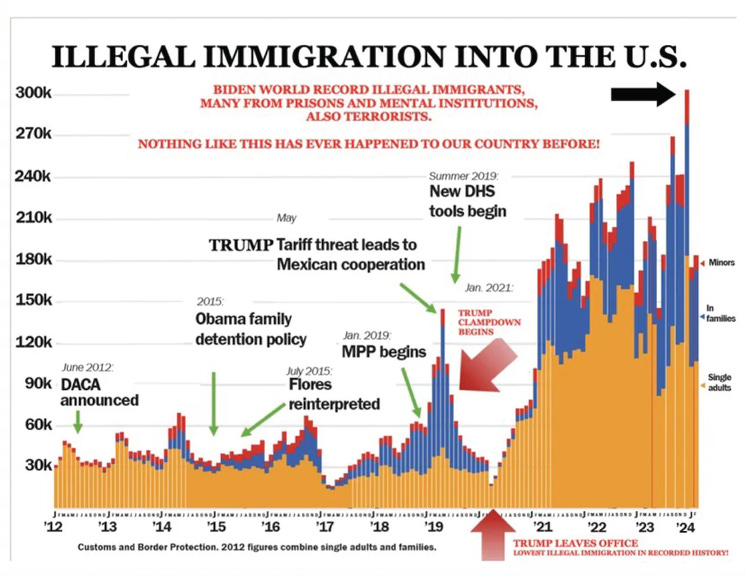
And of course, illegal immigration continued, hitting all-time highs during the Biden Administration.
Democrats on Common Sense Immigration

